Fløibanen’s history
The Fløibanen funicular is one of Bergen’s most popular attractions and has carried both locals and visitors to the top of Mount Fløyen since 1918. Its history is also the story of how the city’s surrounding mountains were made accessible to everyone – not just experienced hikers.
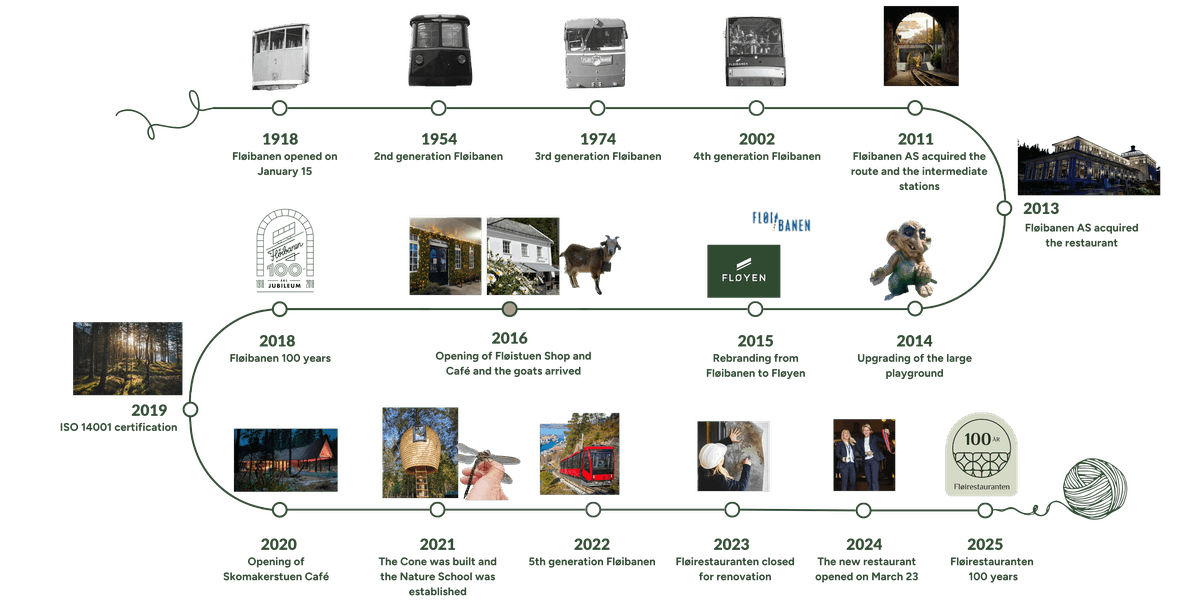
From idea to reality
As early as 1895, the idea of a transport system to Mount Fløyen was proposed by Bergen native and Member of Parliament John Lund. The city council approved the project on the condition that an electrically powered funicular be built. In return for an annual fee, the municipality agreed to grant a four-meter-wide route through the area. The government approved the concession on October 10, 1896. However, the concession holder was unable to raise the necessary capital, and the project was abandoned.
The idea was revived in 1907. The funicular project in Bergen soon gained international attention, with European newspapers reporting on the plans. A/S Fløibanen was established in 1912, with Waldemar Platou serving as the company’s first director. The facility was designed by architect Einar Oscar Schou, while Erling Gjestland was the engineer and construction manager.
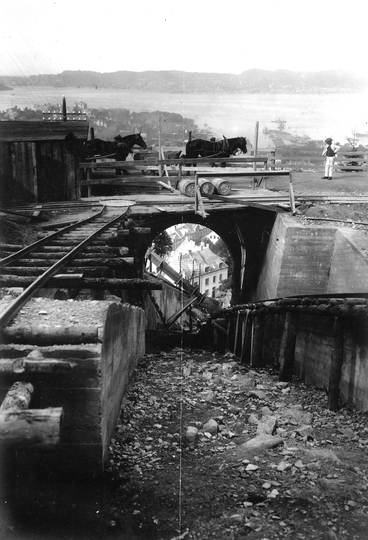
Construction of the Fløibanen began in the autumn of 1914. Originally expected to take about a year and a half, the work was significantly delayed due to World War I and shortages of materials. Fløibanen was finally opened on January 15, 1918, and quickly became popular – both as a means of transport and as an experience for locals and tourists.
Key arguments in favor of the funicular emphasized that it would improve accessibility for the public wishing to use the city’s mountains for recreational purposes
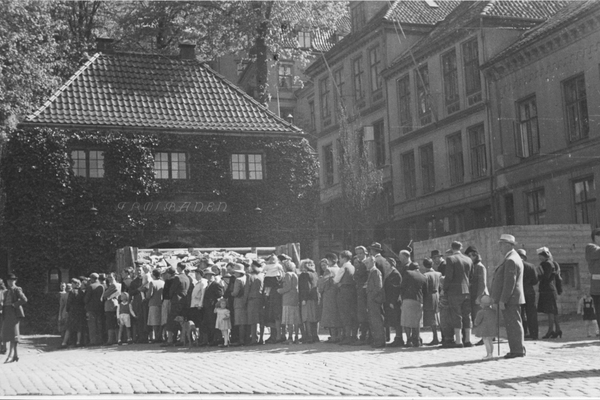
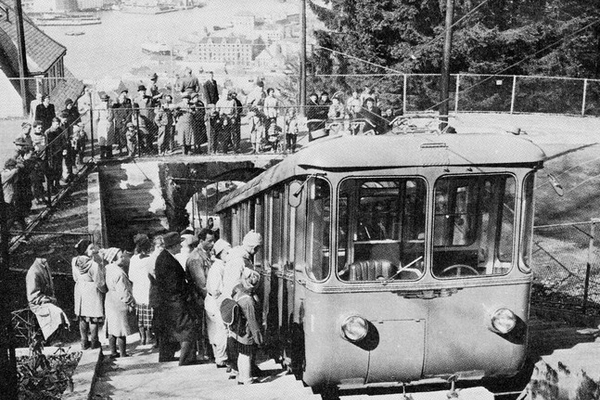
Five generations of Fløibanen
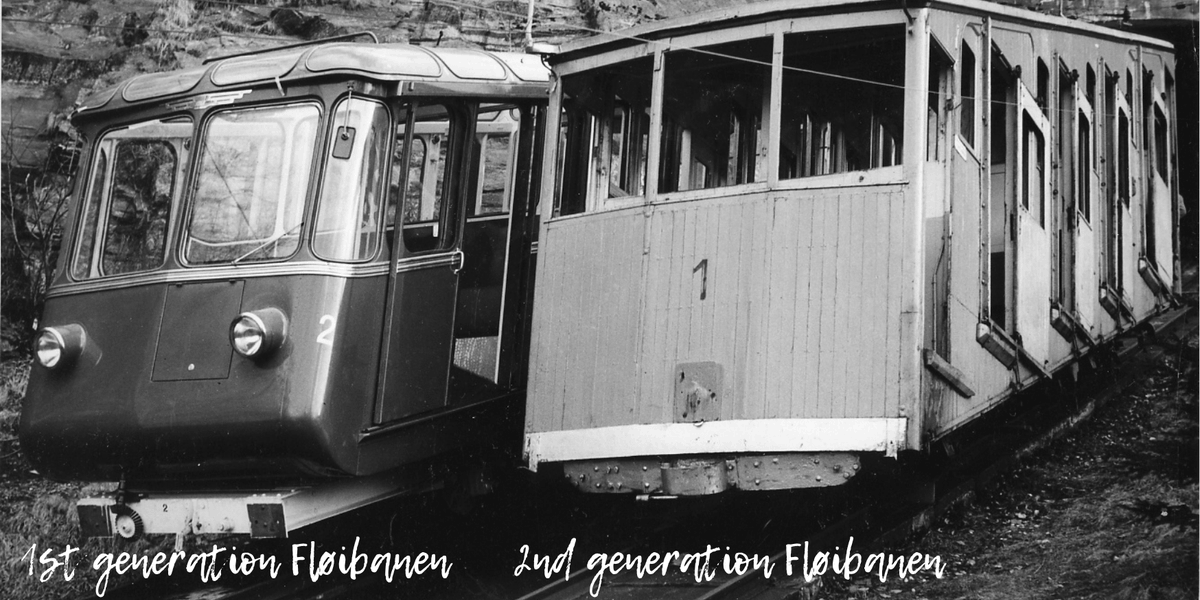
1st generation Fløibanen (1918–1954)
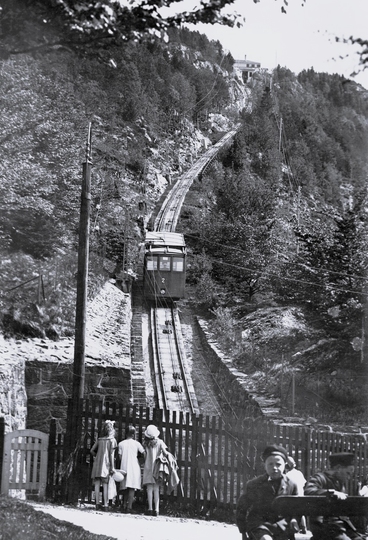
The first Fløibanen cars, made of oiled teak and partly open, were delivered by Maschinenfabrik Esslingen in the German city of the same name. They had a capacity of 65 passengers. The line was powered by a 95 hp electric motor. After 1946, the cars were enclosed, and one was painted red and the other blue. Together with the white lower station building, they symbolized the Norwegian flag in the post-war years.
2nd generation Fløibanen (1954–1974)
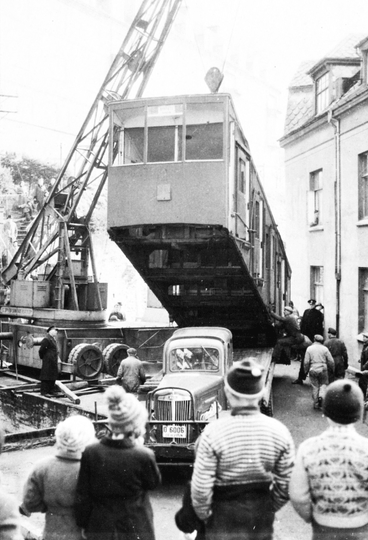
After 36 years, the original cars were replaced in 1954. The new undercarriages were supplied by von Roll in Switzerland, and the cars could carry 75 passengers. From this point on, the system was controlled from the driver’s cabin in the cars. Previously, an operator stationed at Fløyen communicated with the drivers using a signal rod, which the driver extended out of the window to connect with a signal wire.
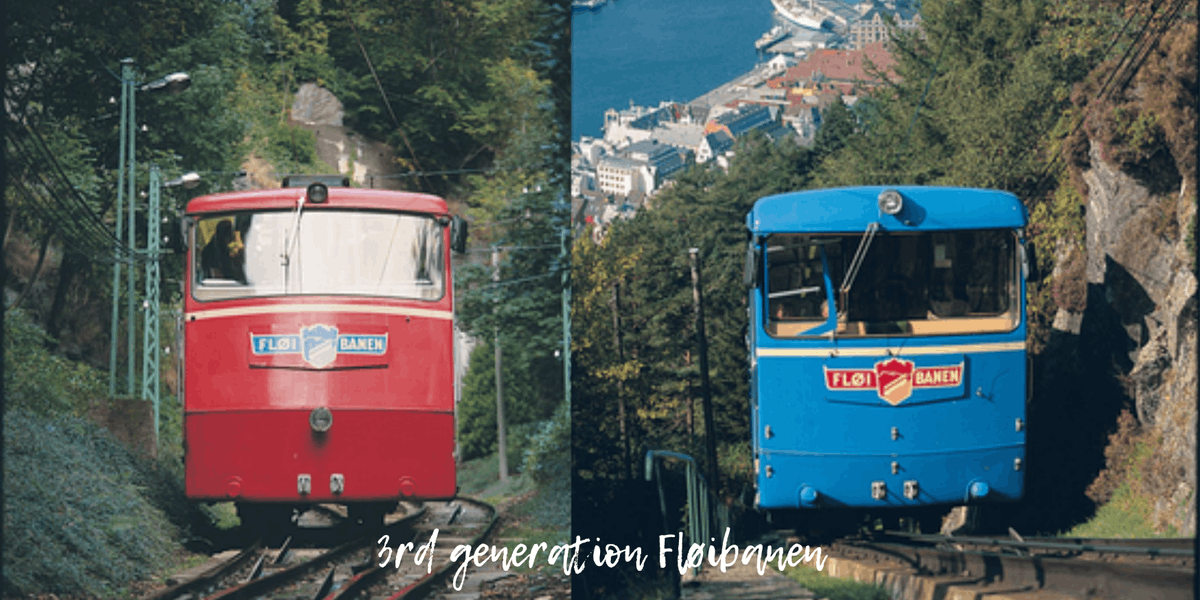
3rd generation Fløibanen (1974–2002)
A new set of cars was introduced in 1974, also supplied by von Roll in Switzerland, with a capacity of 80 passengers. In 1987, the engine room at Fløyen was modernized, introducing radio control – allowing drivers to operate the system via radio signals. A new 190 hp motor was installed. Communication between the two cars was also improved using light signals with feedback indicators.
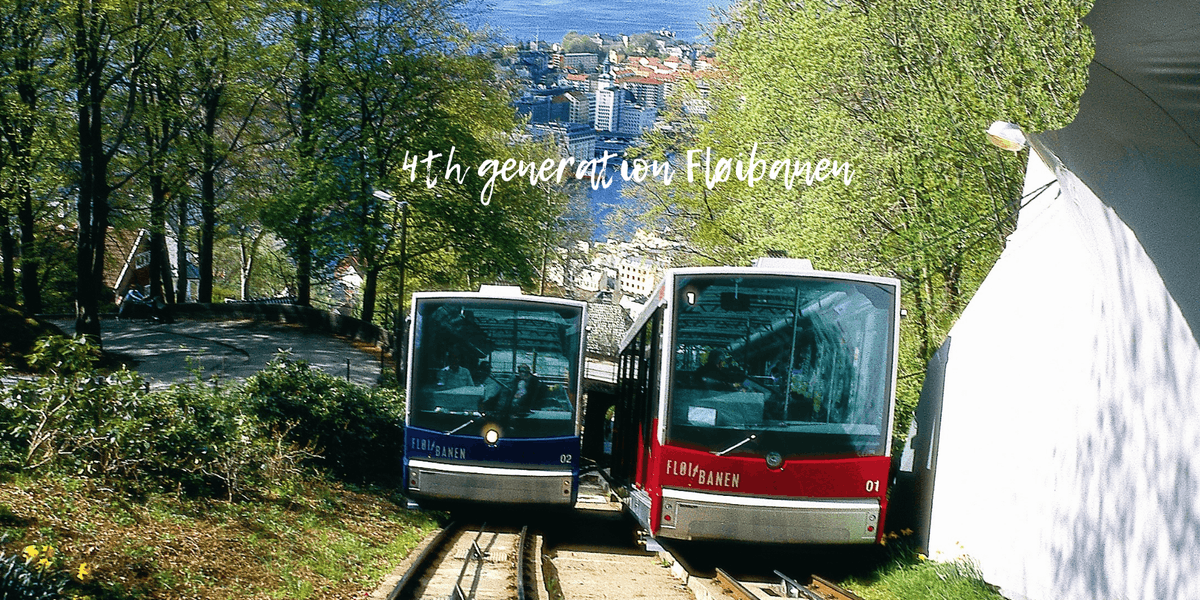
4th generation Fløibanen (2002–2021)
In the autumn of 2002, a complete modernization was carried out, including new cars, tracks, machinery, stations, and ticketing systems. Each car’s capacity increased from 80 to 100 passengers. The cars were specially designed for Fløibanen by industrial designer Espen Thorup and manufactured by Doppelmayr Seilbahnen in Switzerland. They featured a modern design with larger windows, improved comfort and enhanced views for passengers.
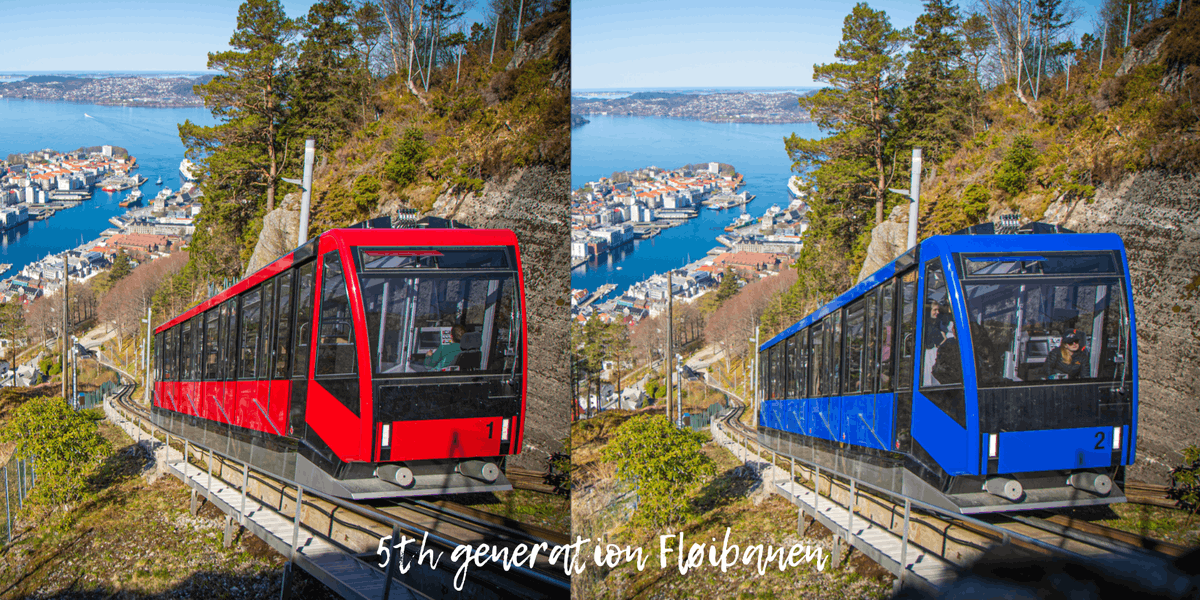
5th generation Fløibanen (2022–present)
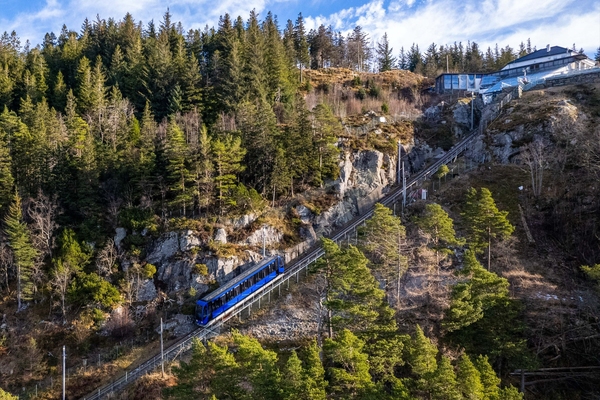
In the autumn of 2021, reconstruction began for the fifth generation of Fløibanen, which is the system in use today. The undercarriages were built by the Swiss company Doppelmayr Tramways Ltd, and the car bodies were delivered by CWA. This marks the most extensive upgrade in Fløibanen’s history, with tracks, machinery and control systems all modernized to contemporary standards. The previous cars and machinery had become worn after years of operation, and growing passenger numbers also required larger capacity. Each car can now carry 120 passengers. All stations have also been designed with universal accessibility in mind, making the journey more comfortable for all users. The system still operates on the counterweight principle, with the two cars connected to the same cable.
The fifth-generation Fløibanen opened on April 1, 2022, and today the line carries approximately 2.4 million passengers annually.
Fløibanen facts
-
Fløibanen was officially opened on January 15, 1918.
-
The two cars are named Rødhette (Little Red Riding Hood) and Blåmann (Blue Man), chosen through a naming competition.
-
The upper station is located 320 meters above sea level.
-
The vertical difference between the lower and upper stations is 302 meters.
-
The line is 848 meters long, with a gradient increasing from 15 to 26 degrees at its steepest.
-
The intermediate stations are Promsgate, Fjellveien and Skansemyren.
-
The current cars each have a capacity of 120 passengers.
-
Fløibanen operates at a speed of 4.0 m/s, and the journey typically takes about 6 minutes.
-
The track gauge is 100 cm.
-
The system is powered by a 355 kW AC motor, controlled from the cars via signals transmitted through an inductive cable. Fløibanen is an environmentally friendly mode of transport, as it runs on electricity and produces no emissions.
-
Each car weighs 21 tonnes, and a fully loaded car weighs around 30 tonnes.
-
The current cars are 16.49 meters long.
-
The cable is 45 mm thick and has a total weight of 8,880 kg.
-
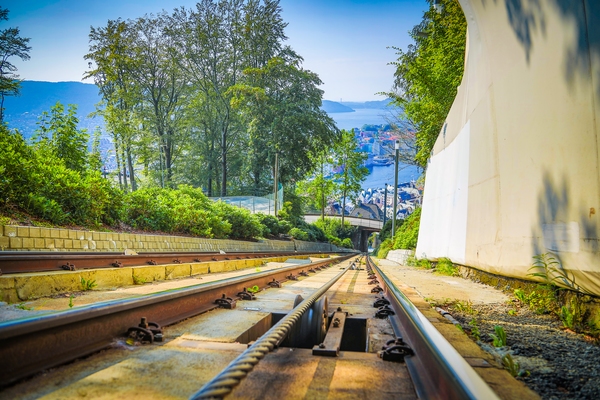
The cable is 960 meters long and runs as a continuous loop from one car to the other, meaning the cars are connected at opposite ends of the same cable. The cable is attached to the cars with an adjustable coupling and runs along pulleys throughout the line. The greatest tension in the cable occurs when a car passes the steepest section (26 degrees), approximately 67 meters below the upper station.
Safety – our top priority
Safety has always been a central focus for Fløibanen. Annual inspections by the Norwegian Cableway Authority include brake tests, cable inspections and general system checks. These are complemented by regular inspections carried out by the railway’s own staff in accordance with internal procedures and control systems.
Fløibanen has never experienced any serious accidents. A highly comprehensive braking system, operating both automatically and manually, ensures that the cars stop immediately in the event of any irregularities. Each of the two cars is equipped with three track brakes that engage if the speed becomes too high, bringing the cars to a stop within seconds. In addition, the machinery includes both a service brake and an emergency brake, which are automatically activated if any malfunction occurs. Fløibanen is also equipped with a diesel generator in case of a power outage.
Given the nature of this type of transport, exceptionally high safety standards are required, the funicular can confidently be regarded as one of the safest modes of transport available.